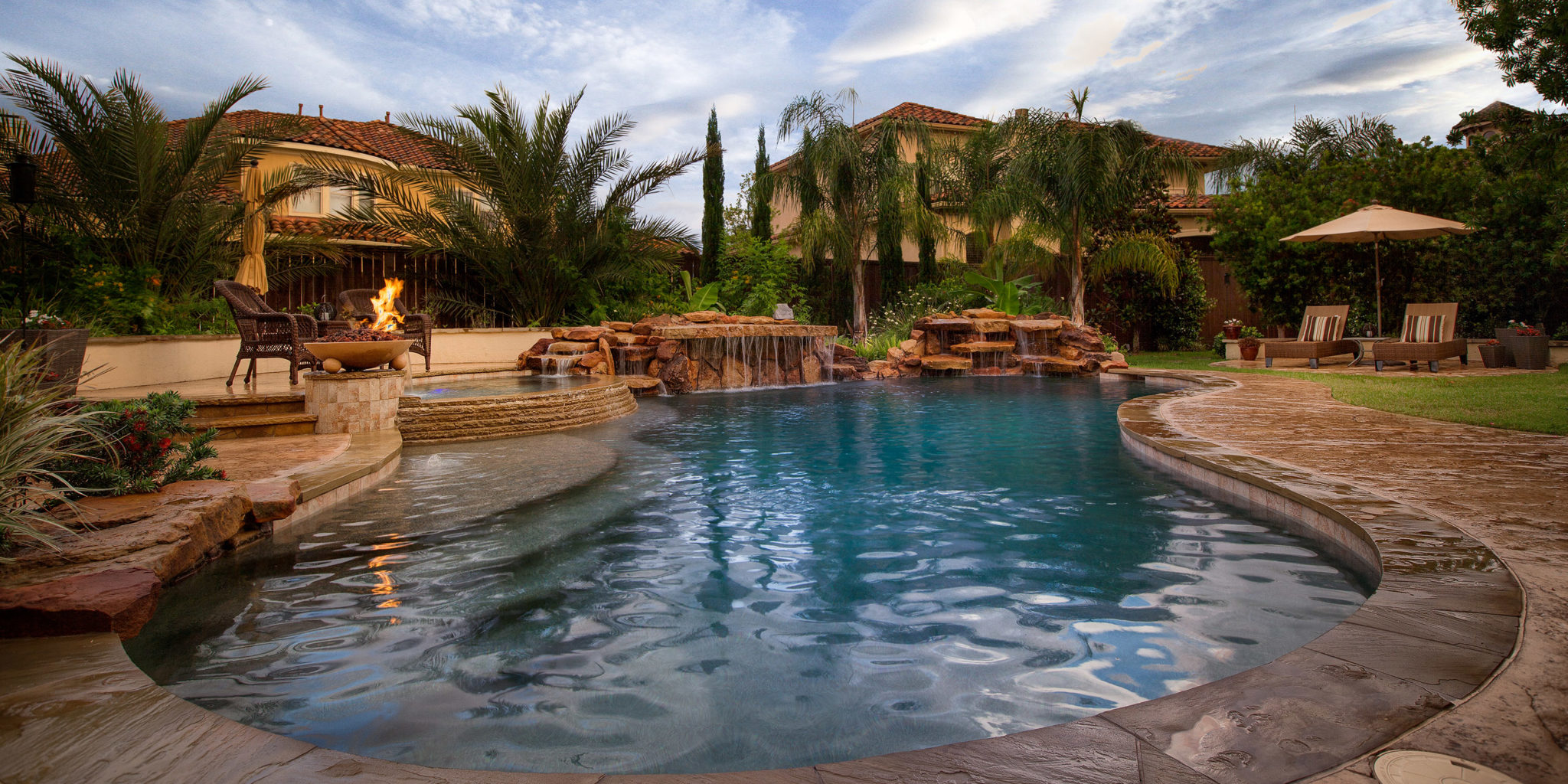
So, you’re scrolling. You’ve probably seen thousands of images of swimming pools by now. Most of them look exactly the same: that impossibly turquoise water, a perfectly placed lounge chair, and maybe a stray palm tree reflecting in a glass-smooth surface. It’s pretty, sure. But if you’re actually trying to build a pool or renovate an old, cracked concrete eyesore in your backyard, these glossy stock photos are kind of useless. They don't show you the plumbing. They don't show you how the water looks when the wind is actually blowing or how a dark bottom pool hides debris (and sometimes snakes).
Finding the right visual inspiration is harder than it looks because most of what we see online is heavily edited or, increasingly, generated by AI.
Honestly, the "perfect" pool photo is often a lie. You see a gorgeous infinity edge overlooking a canyon and think, "I want that." Then you realize your backyard is a flat 50-foot lot in the suburbs with a drainage issue. Real-world images of swimming pools need to provide more than just "vibes." They need to show scale, texture, and how materials like travertine or pebble-tec actually hold up under the sun.
The Psychology of the Blue Water Effect
Why are we so obsessed with these pictures? It's not just about wanting a place to cool off during a July heatwave. Environmental psychologists often talk about "Blue Space." This is the idea that being near water—or even looking at high-quality images of it—lowers cortisol levels. Wallace J. Nichols, author of Blue Mind, spent years researching how water affects our brains. He found that the sight of water induces a mildly meditative state.
When you look at images of swimming pools, your brain isn't just evaluating a home improvement project. It’s searching for an escape. This is why the most successful pool photography uses a "vanishing point" technique. By positioning the camera at water level, the photographer makes the pool feel endless. It tricks your lizard brain into thinking you’re at a vast lake or the ocean, rather than a 15x30 hole in the ground filled with chlorine.
But here is the catch.
Most people look at these photos and ignore the "hardscape." That’s the stuff around the water. The stone, the decking, the fence. If you look at a photo of a pool and love it, try covering the water with your hand. Do you still like the picture? If the answer is no, you don't like the pool; you just like the color blue.
What the Professional Images Don’t Tell You
If you’re using images of swimming pools to plan a project, you have to be a bit of a detective. Professional architectural photographers use a few tricks that can lead you astray if you aren't careful.
The Golden Hour Cheat. Almost every high-end pool photo is taken at sunrise or sunset. This creates long, soft shadows and a "glow" that you will never see at 2:00 PM on a Tuesday when the sun is beating down and making the water look flat and harsh.
The "Wet Look" Sealer. Look closely at the stone around the pool in magazines like Architectural Digest. It often looks vibrant and dark. That’s usually because they’ve just hosed it down right before the shot, or they’ve applied a high-gloss sealer that can be incredibly slippery (and dangerous) in real life.
Lens Distortion. Wide-angle lenses are the industry standard. They make a small lap pool look like an Olympic training center. If you see a photo where the pool looks massive but the house in the background looks weirdly small or slanted, that’s a lens trick.
Why Material Choice Matters More Than Shape
People get hung up on the shape of the pool—kidney, rectangular, freeform. But in images of swimming pools, the material is what dictates the "feel." Take "Plaster" vs. "Aggregate."
Standard white plaster gives you that classic, bright Windex-blue water. It’s what you see in 90% of suburban photos from the 1990s. But modern high-end images often feature darker finishes like "Midnight Blue" or "Black Onyx" pebble finishes. These create a mirror effect. They reflect the trees and the sky. They also stay warmer because they absorb sunlight.
The downside? You can’t see the bottom clearly. If you have kids, a black-bottom pool can be a safety nightmare because you can't easily spot a swimmer in distress at the bottom. The photos won't tell you that. They just show you a moody, sophisticated aesthetic.
How to Spot a "Real" Pool Photo
When you’re browsing Pinterest or Instagram, look for "candid" shots. These are the ones taken by homeowners, not professional firms. Why? Because they show the clutter. They show the pool cleaner (the "vacuum") sitting in the corner. They show the leaf skimmer.
A "real" image tells you about maintenance.
If you see a pool surrounded by massive oak trees in a photo, it looks lush. In reality, that homeowner is spending four hours a week fishing leaves out of the filter. If the pool has no "tanning ledge" (that shallow area for lounge chairs), it might look sleeker, but it’s less functional for families.
The Rise of the "Plunge" and "Spool"
Lately, the most popular images of swimming pools aren't of massive estates. They are of "plunge pools" or "spools" (spa-pools). These are tiny. Sometimes only 8x10 feet.
This trend is a response to smaller urban lots and skyrocketing construction costs. In 2023 and 2024, the cost of raw materials like shotcrete and PVC piping went up significantly. People started realizing they didn't need a 40-foot pool to get the "Blue Mind" benefits. A small, heated, well-designed plunge pool offers the same visual impact in a photo and the same cooling benefits in person, for about 40% less money.
Trends That Actually Work (and Those That Don't)
Let’s talk about the "Sun Shelf." You’ve seen these in every luxury resort photo. It’s a shallow area, maybe 6-12 inches deep, where you put those white plastic Ledge Loungers.
- The Pro: It looks incredible in photos. It’s the ultimate lifestyle flex.
- The Con: Unless you live in a climate where the water stays very warm, that shallow water gets cold fast. Also, those chairs can cost $600 to $1,000 each.
Then there’s the "Infinity Edge." It looks like the water just drops off into space. In images of swimming pools, this is the gold standard of luxury. But look at the mechanics. You need a "catch basin" below the edge. This basin often collects debris, grows algae if not brushed, and requires an extra pump that runs up your electricity bill. It’s a "photo-first" feature. If you have a view of a lake or the ocean, it's worth it. If you're looking at your neighbor's fence, it’s a waste of $20,000.
Lighting: The Secret Ingredient
If you want your own pool to look like the pictures, it’s all about the LEDs. Older pools had one giant incandescent "stadium light" that made the water look like a crime scene at night. Modern images of swimming pools use color-changing LED niches.
Pro tip: if you want that high-end look, don't just light the water. Light the trees behind the pool. This creates depth. If the area behind the pool is dark, the pool looks like a glowing hole in the ground. If the landscaping is lit, the pool becomes part of a larger outdoor "room."
Navigating the AI Fakes
We have to address the elephant in the room: Midjourney and DALL-E.
A huge chunk of the images of swimming pools currently circulating on social media are fake. They aren't real places. You can tell because the physics are often wrong. Look at the water's reflection—does it actually match the house? Look at the stairs—do they lead somewhere a human could actually walk, or do they disappear into a wall?
Contractors are currently dealing with a nightmare where clients bring in AI-generated photos and ask for a quote. The problem is that AI doesn't understand structural engineering. It will draw a cantilevered pool hanging off a cliff with no visible support.
When searching for inspiration, always check the source. Is it a real builder’s portfolio? Is there a location listed? If not, it’s probably a digital hallucination.
Technical Reality Check
Before you get too attached to a specific image, consider your local building codes.
Many of the most beautiful images of swimming pools you see are from Australia or Europe, where fencing laws are different. In many parts of the U.S., you are required to have a 4-foot fence immediately surrounding the pool. That "seamless" look where the grass meets the water? It might not be legal in your county.
Also, consider the "Deck-to-Water" ratio.
A common mistake people make after looking at too many photos is making the pool too big and the deck too small. You spend 10% of your time in the water and 90% of your time on the deck. If your photo inspiration shows a massive pool with only two feet of stone around it, it’s a "swim" pool, not an "entertaining" pool. You won't have anywhere to put a table, a grill, or even a towel rack.
Actionable Steps for Using Pool Imagery
If you are in the planning stages, don't just "save" images. You need to categorize them to make them useful for a builder or designer.
- Create a "Water Color" folder. Only save photos where you love the specific shade of the water. Is it Caribbean turquoise? Deep lagoon green? Navy blue? This helps you pick the right interior finish.
- Create a "Coping" folder. The coping is the "lip" of the pool. Do you like the squared-off modern look or the rounded "bullnose" look?
- Search for "Night vs. Day." Try to find photos of the same pool in both lighting conditions. This will show you how much the aesthetic shifts when the sun goes down.
- Check the "Surround." Look at what's around the pool. Do you like pavers, poured concrete, or natural stone?
Images of swimming pools are a tool, not a blueprint. Use them to identify the textures and colors that make you feel relaxed, but always cross-reference them with the boring, unsexy stuff like drainage, local permits, and maintenance requirements.
Stop looking at the 50-foot infinity edges if you have a 20-foot backyard. Start looking for "Small Backyard Pools" or "Stock Tank Pools" if you're on a budget. The most beautiful pool is the one that actually gets built and used, not the one that stays on a Pinterest board because it was physically impossible to recreate.
To move forward with your project, start by identifying your "Hard Constraints." Measure your actual backyard dimensions and use a piece of graph paper to sketch out the footprint. Once you have a rough idea of the size that fits, filter your image searches specifically by those dimensions (e.g., "12x24 pool ideas") to ensure your inspiration matches your reality. After that, contact a local pool builder to see which of your saved "finishes" are actually available in your region, as pebble and stone types vary significantly by local supply chains.